


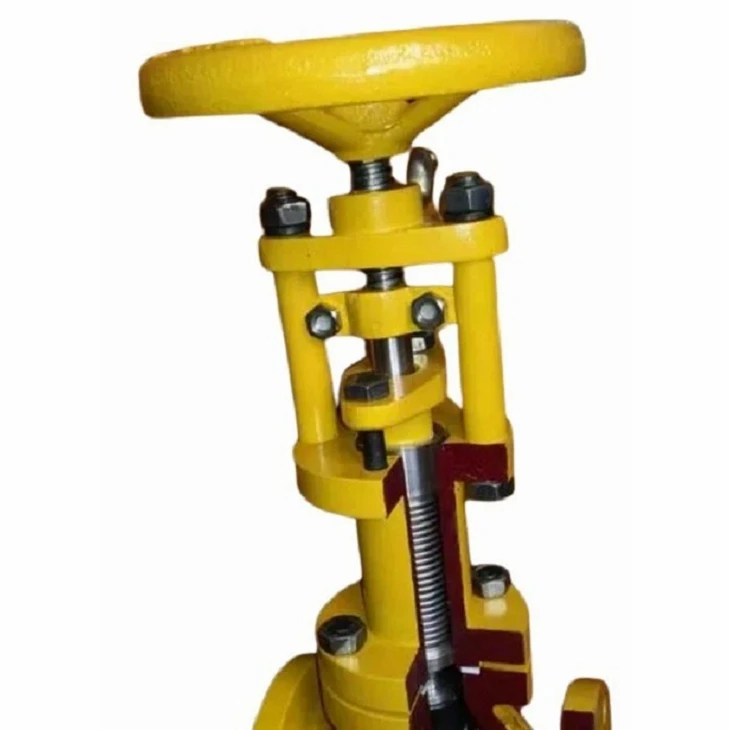
Adjustable Flat Gate Valve
Zhejiang Advanced Technology Valve Co., Ltd. is a technology-based manufacturing enterprise, which integrates designing, manufacturing and marketing valves and owns one stop service. The company's leading products include flat gate valves with diversion holes, flat gate valves without diversion, expansion double gate flat gate valves, hard-sealed double gate flat gate valves, and special flat gate valves for alumina plants.
Description
Your Professional Adjustable Flat Gate Valve Suppliers in China
Zhejiang Advanced Technology Valve Co., Ltd. is a technology-based manufacturing enterprise, which integrates designing, manufacturing and marketing valves and owns one stop service. The company's leading products include flat gate valves with diversion holes, flat gate valves without diversion, expansion double gate flat gate valves, hard-sealed double gate flat gate valves, and special flat gate valves for alumina plants.
Wide Range of Applications
The valve products produced by the company are widely used in petroleum, natural gas, chemical industry, polysilicon, coal chemical industry, power station, metallurgy, papermaking, medicine, military industry and other industries.
Advanced Equipment
The company has various precision machining and testing equipment, large-scale surface CNC grinders, sphere machining centers and other new technologies, as well as the first-class full-performance testing equipment in the country.
18 Month Warranty
We offers an 18-month warranty for each valve. Within these 18 months, if our products fail, leak, or even damage during use (excluding human factors), we will be responsible for replacing the products with quality problems and delivering them to your warehouse.
Excellent Pre-sales Service
Our pre-sales service includes the communication and confirmation of a series of transaction terms before you place an order, including price, product drawings, trade terms, delivery date, etc. In addition, in the process of order production, we will let you know the status of the product in the form of pictures and videos to confirm the production process.
Introduction of Adjustable Flat Gate Valve
The flat gate valve is a sliding valve whose closing part is a parallel gate. The closing member can be a single gate or a double gate with a distraction mechanism in between. The pressing force of the gate to the valve seat is controlled by the medium pressure acting on the floating gate or the floating valve seat. If it is a double gate plate gate valve, the expansion mechanism between the two gates can supplement this pressing force. The flat gate valve can be divided into manual flat gate valve, pneumatic flat gate valve and electric flat gate valve according to the driving mode. According to the use and occasion, it can be divided into diversion hold flat gate valve, non-diversion hole flat gate valve, oil field flat gate valve, pipeline flat gate valve, gas flat gate valve, etc.
Our Related Products

It has the advantages of simple and compact structure, reasonable design, reliable sealing, light and flexible operation, small size, smooth channel, low resistance, easy installation and easy disassembly.

When the valve is fully opened, the flow resistance coefficient is very small, and the valve will eliminate the function of the valve disc and the dirt on the sealing surface every time the valve is opened and closed.

Normal Temperature Flat Gate Valve
Gate valve is a commonly used pipeline valve, and its working principle is to control the flow of the medium by lifting the gate plate. Gate valve has simple structure, good sealing performance and small flow resistance, and is widely used in various industrial fields.

The packing is made of flexible graphite ring and graphite packing, reliable sealing, light and flexible operation.

It is widely used in oil and water steam pipelines such as petrochemical industry and thermal power plants to connect or cut off the intermediate quality of pipelines.

The use of bellows as a sealing element can adapt to the temperature, pressure and corrosion of different media to ensure the sealing performance of the valve.

Changed the traditional gate can only be fully open or trap, can not be adjusted and throttling, need to install another valve for adjustment and throttling, can not meet the needs of the use of pipelines.

It can be installed in the ground, which can save the cost of digging and fixing the wall of the large-caliber ground well, and the surface exposure range is small, which will not affect the beautification of the road, saving investment and eliminating the safety problems caused by the loss of the ground well cover.

Low temperature valve refers to the medium temperature of -40℃~-196℃ valve, common low temperature valves are divided into low temperature butterfly valve, low temperature gate valve, low temperature ball valve, low temperature globe valve, low temperature check valve, low temperature throttle valve and so on.
Product Specification
|
Size |
From 2″ to 48″ |
|
Pressure |
150 – 1500LB |
|
Material |
WCB, LCB, WC6, WC9, CF8, CF3, CF3M, and CF8M |
|
Design and production standard |
API 600, API6D and ASME B16.34 |
|
End to End |
ANSI B16.5, ASME B 16.47, ANSI B 16.25 |
|
Test Standard |
API598, API6D |
|
Actuation |
Can operate with lever, gear box, pneumatic or electric actuator with handwheel for emergencies. |
|
Medium |
The valve is suitable for several media including water, steam, oil, gas, petrol products, nitric acid, acetic acid, etc. |
|
Working temperature |
From -46ºC or -50ºC (stainless steel constructions) and -29ºC (carbon steel constructions) up to 600℃ |
|
Packing |
To be packed in suitable wooden cases as per client's option or customized |
|
Shipping & Delivery |
20-25 days lead time; deliver by ship from Ningbo port or Shanghai port |
|
Notes |
Serial valve connecting flange and butt-welding terminal size can be designed at customers' request. The material of the main parts and sealing surface of the valve can be designed and selected according to the actual working conditions or the special requirements of users. |
How Does an Adjustable Flat Gate Valve work
The valve is an asymmetrical flat valve body structure. It combines the valve body and valve cover of the ordinary gate valve into one. And the sanitary valve body is designed into a flat square. This kind of design reduces the structural size of the valve body, saves the number of connecting bolts between the valve body and the valve cover, effectively reducing the weight of the valve.
The valve seat uses a stand-alone design, combining the valve seat and valve interface of the ordinary gate valves into one. For the same valve body, replacing different valve seats can simply change the type of interface of the valve. This effectively improves the commonality and maintainability of the valve body, while avoiding the problem in which deformation of the valve body under high pressure results in the poor sealing performance of the valve.
Standard Specifications
API 600
Bolted Bonnet Steel Gate Valve for Petroleum and Natural Gas Industries.
DIN3352
Bolted Bonnet Steel Gate Valve for Petroleum and Natural Gas Industries.
ASME B16.10
Face to Face and End to End Dimensions of Valves.
BS 1414
Specification for Steel Wedge Gate Valves (Flanged and Butt-welding Ends) for the Petroleum, Petrochemical and Allied Industries.
MSS SP-25
Standard Marking System for Valves, Fittings, Flanges and Unions.
ASME B16.47 Series A
Large Diameter Steel Flanges: NPS 26 Through NPS 60 Metric/Inch Standard.
ASME B16.34
Valves Flanged, Threaded and Welding Ends.
ASME B16.5
Pipe Flanges and Flanged Fittings: NPS 1/2 through 24.
ASME B16.25
Buttwelding Ends.
Structural Features of Adjustable Flat Gate Valve


This series of products adopt the new floating seal structure, which is suitable for the opening, closing and adjusting devices of control media such as oil and natural gas with pressure less than 15.0MPa and temperature from -29 ℃ to 121 ℃. The product has a novel structural design and material selection. Appropriate, rigorous test, light operation, strong anti-corrosion, abrasion resistance and erosion resistance. It is an ideal new equipment in the petroleum industry.
● Adopting floating valve seat, two-way opening and closing, reliable sealing and flexible opening and closing.
● The gate is provided with guide strips for precise guidance, and the sealing surface is spray welded with carbide, which is resistant to erosion.
● The valve body has a high load-bearing capacity and the channel is straight-through. When fully opened, it is similar to the gate diversion hole and the straight pipe, and the flow resistance is very small. The valve stem adopts composite filler, multiple seals, making the seal reliable and low friction.
● When closing the valve, turn the handwheel clockwise to move the shutter down to the bottom. Due to the pressure of the medium, the inlet seal seat is pushed towards the direction of the shutter to form a larger seal specific pressure, thus forming the first seal. At the same time, the shutter is pressed against the sealing seat at the outlest end to become a double seal.
● Due to the double seal, the consumable parts can be replaced without affecting the work of the pipeline. This is an important feature that our products take priority over similar products at home and abroad.
● When the gate is open, turn the hand wheel counterclockwise, the gate moved up, and the diversion hole and channel hole intersect. With the rise of the gate, the through hole gradually increases, and when the limit position is reached, the diversion hole and the passage hole coincide, and they are fully opened at this time.
Our Certificates
We guarantee that all our products have passed the quality control and stringent regulations imposed not only by our company but also by international organizations. Our certifications assure that our product line is top grade by industry standards.


Common Problem of Adjustable Flat Gate Valve
Hot Tags: adjustable flat gate valve, China adjustable flat gate valve
Send Inquiry
You Might Also Like


